Canvas: UM's Next-Gen Learning Management System

Teaching in Canvas

Compare Blackboard workflows and Canvas features.

Course Migration

Review, import, and publish migrated courses.

Canvas Champions

Connect with faculty peers for practical guidance.

Training & Support

Explore workshops, guides, and self-paced resources.

Canvas Month

Virtual and in-person support from Aug 10 through Sept 4.

Explore ongoing guidance and Canvas support throughout.

As of Fall 2026, Canvas is the University of Miami’s only learning management system for instruction. Faculty can continue building their Canvas skills and receive assistance with course content, tools, and teaching workflows.

Explore Canvas trainings and support opportunities.


Overview

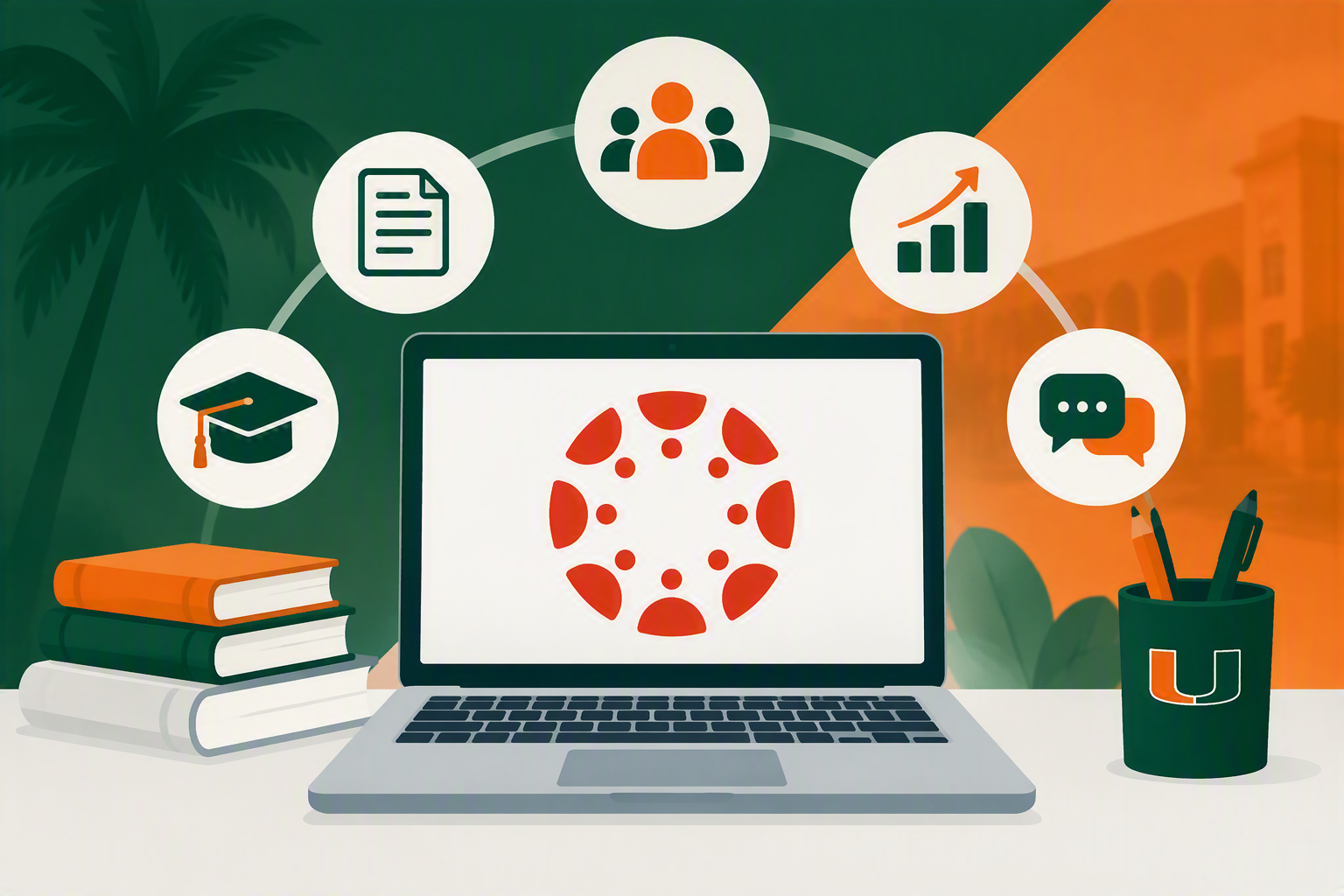
Canvas is the University of Miami's next-generation learning management system (LMS). It's mobile-friendly, intuitive, and packed with tools that enhance teaching, learning, and accessibility.

Access Canvas Today:

Visit Canvas and sign in with your University of Miami credentials:

canvas.miami.edu

Cards

Why Canvas Matters:

Canvas was selected with input from University of Miami faculty and students to support the University’s evolving teaching and learning needs.

Its intuitive, flexible, and accessible tools support engaging instruction and continued innovation across the University.

To learn more about Canvas and UM’s transition, view the recorded information session.
View Recorded Info-Session

Canvas Today:

As of Fall 2026, Canvas is the University of Miami’s official and only learning management system for instruction.

Blackboard is now in archive mode and is no longer used for teaching.

Faculty can access current courses and migrated Blackboard content directly in Canvas.

Learn About Course Content Migration

Looking Ahead:

Faculty Canvas Champions continue to provide peer guidance and practical Canvas support

After Spring 2027, archived Blackboard content will remain available for viewing only.

Faculty have access to ongoing Canvas training, resources, and support.

Explore Canvas Trainings and Resources


Transition to Canvas

On behalf of the Office of the Provost – "The University of Miami is pleased to announce the transition to Canvas as our next-generation learning management system (LMS). This decision reflects extensive feedback from students and faculty who participated in the 2024–2025 LMS Evaluation Initiative, which included piloting Canvas alongside Blackboard. Their insights informed faculty governance's vote in favor of Canvas, recognizing its ability to better support the University's evolving academic needs."

Transition Timeline:

Explore the milestones that shaped UM's journey to Canvas—from faculty and student feedback, evaluation, and governance through migration, expanded support, and full adoption in Fall 2026.

EXPLORE OUR JOURNEY TO CANVAS


Why Canvas?

Canvas was selected after carefully reviewing multiple learning platforms to support innovation at the University of Miami.

Students and faculty were engaged in a pilot program and shared feedback through surveys, tickets, and conversations. This input was analyzed and presented to the Academic Computing Advisory Committee, Academic Deans Policy Council, and the Faculty Senate. Each group voted in favor of adopting Canvas over Blackboard Ultra based on feedback and platform comparisons.

Aligning with UM's Vision for Teaching, Learning, and Technology:

Feedback-Informed

Driven by insights from students and faculty during the LMS evaluation process.

Modern Instruction

Supports inclusive, student-centered teaching with a streamlined design experience.

Built for Innovation

Canvas positions UM for future innovation and aligns with peer institutions.


Key Benefits

Everything you know—organized more intuitively.

Canvas has core features such as:

  • Pages, Files, Modules: Supports the creation/uploading of content, various media types, including audio/video, with tools for creating accessible content.
  • Announcements, Inbox: Enables various communication channels with customizable notifications.
  • Assignments, Grades, Quizzes: Provides tools for creating quizzes, and assignments. Offers a customizable gradebook with multiple feedback options and integration with plagiarism tools.
  • Groups, Discussions: Supports collaborative content creation, group work, and discussion forums.
  • Canvas Apps: Offers a responsive mobile interface for easy access to various devices. 
  • Progress: Provides tools for tracking student progress, activity, and retention.

  • Lucid Enterprise Access: Use Lucidchart and Lucidspark directly within Canvas for professional diagramming and collaborative whiteboarding.
  • Canvas Commons Integration: Share and reuse content through a learning object repository used by educators across institutions.
  • Advanced Document Editor: Create rich, dynamic content pages with embedded media, tables, and design flexibility.
  • New Quizzes: Leverage enhanced item banks, multiple due dates, to deliver more flexible and data-rich assessments.
  • Enhanced SpeedGrader: Enjoy fast load times, improved rubrics, and inline annotation tools for efficient, flexible grading.
  • Blueprint Courses: Push template content to multiple course sections, ensuring consistency across departments or large programs.
  • Smart Search: Use natural language queries like "What's due next week?" to quickly locate content, assignments, or rubrics.

Frequent improvements based on community feedback.

Canvas is updated regularly with:

  • New features
  • Bug fixes
  • Monthly in-platform announcements in the "Help" menu

Training

In-depth training is being provided for UM faculty. Click here to explore trainings for faculty and staff.

Get direct guidance on common questions and explore advanced features as an instructor or student.

Cards


Third-Party Tool Availability

Please keep in mind that some tools are already available in Canvas, some will be ready later on, and others are not yet supported.

Accordion Group

Open All Tabs
  • Currently Installed

    Tool
    BrightSpace/BARBRI Packback
    Cengage Gateway Pearson
    Course Reserves (uReserves) Perusall
    Echo360 PlayPosit
    Follett Course Materials Qwickly Attendance
    Follett Willo Qwickly Course Tools
    Gradescope Research Guides
    Honor Education Respondus Lockdown Browser
    Kaltura Sage Vantage
    LinkedIn Learning Suitable
    Macmillan Learning TopHat
    MATLAB Grader Turnitin (Replacing SafeAssign)
    McGraw Hill Voicethread
    Microsoft OneDrive Wiley Plus 
    Microsoft Teams Yuja Panorama (Replacing Ally)
    Norton Learning Tools Zoom

  • Currently Unavailable – Workarounds Provided

    Tool Workaround
    H5P Contact your publisher representative for Canvas support.
    Rising Software Contact your publisher representative for Canvas support.

    If these limitations impact your course, consider planning for Spring 2026 teaching in Canvas.


What Happens to Blackboard?

Blackboard has been retired from instructional use and is moving through the remaining stages of the retirement timeline detailed below. 

Important: As of Fall 2026, Canvas is the University of Miami’s only LMS for instruction.

Explore Teaching in Canvas the Way You’re Used To to see how common Blackboard workflows translate to Canvas.

Transition Timeline

Spring 2026

Blackboard remained available for teaching while faculty prepared their courses and migrated content to Canvas.

Summer 2026

Summer 2026 was the final term in which Blackboard could be used for instruction.

Fall 2026

Canvas is now the official and only learning management system for all University of Miami courses. Blackboard is in archive mode and is no longer available for instructional use.

December 31, 2026

Vendor support for the Blackboard Learn Original experience officially ends. Blackboard will remain in archive mode and cannot be used for instructional activity.

Spring 2027

Blackboard will remain in archive mode. Faculty and staff should review and retain any previous course content they may need before editing capabilities are removed.

After Spring 2027

Previous Blackboard course content will remain available for reference, in read-only mode. Instructors will only be able to view past materials, submissions, and grades. Content can no longer be edited, and users cannot create courses, accept submissions, or grade work.


Frequently Asked Questions

Everything you need to know as the University of Miami transitions from Blackboard to Canvas.

Quick Links: General Information - Features and Tools - Grading and Analytics - Course Management - Training and Support

General Information

Accordion Group

Open All Tabs
  • How do I access Canvas?

    Faculty and students can access Canvas at canvas.miami.edu using a University Login ID and password. Canvas can also be accessed through courses.miami.edu.

  • How do I access my courses?

    Once logged in to Canvas (canvas.miami.edu), use the dashboard to access your courses, or the Courses page. Courses will have a simple template that you can customize.

  • What was the timeline for UM’s transition to Canvas?

    Spring 2026 was the final full semester in which Blackboard remained available for instruction, and Summer 2026 was the final term in which Blackboard could be used for teaching. As of Fall 2026, Canvas is the University’s official and only learning management system for instruction.

    Blackboard is now in archive mode and is no longer used for teaching. After Spring 2027, previous Blackboard course content will remain available for viewing, but it can no longer be edited.

  • Why did UM transition to Canvas?

    Canvas was selected following a comprehensive evaluation of Canvas and Blackboard Ultra. Faculty and students participated in pilots, surveys, support interactions, and other feedback opportunities to evaluate both platforms.

    The findings were presented to University faculty-governance groups, which supported the adoption of Canvas. Canvas was selected for its modern, intuitive, and accessible experience and its ability to support the University’s evolving teaching and learning needs. The end of vendor support for the Blackboard Learn Original experience also contributed to the need for a new platform.

  • What Blackboard content was migrated to Canvas?

    Actively used Blackboard course content from Spring 2024 through Summer 2026 was included in the bulk migration to Canvas. Migrated materials may include assignments, quizzes, presentations, files, and announcements.

    Grades, enrollment data, and other student-specific information were not transferred. Faculty should review migrated content before using it in a live Canvas course because some materials may require updates or relinking.

  • Were students’ saved files or assignments transferred from Blackboard to Canvas?

    No. Files, assignments, and other materials uploaded by students were not automatically transferred to Canvas. Students should download and retain any personal Blackboard files they wish to keep before Blackboard’s archive functionality becomes limited to viewing after Spring 2027.

  • Can instructors create an organization or an orientation course on Canvas now?

    Faculty and staff may request a manually created Canvas course for eligible student co-curricular learning needs. Please review the criteria and submit a request through the Canvas Course Request page. For other resource-sharing, collaboration, or training needs, Microsoft Teams, Microsoft 365, or ULearn may be a better option.

  • Will content from organizations or manually created courses automatically transfer to Canvas?

    No. Organizations and manually created courses will not be transferred to Canvas through the bulk-migration process. Please export and retain any content you need from Blackboard. If you need an eligible manually created course in Canvas, review the criteria and submit a request through the Canvas Course Request page.

  • How do I start building a course in Canvas?

    Instructors enrolled in courses for the target semester can access their course shell via the Canvas (canvas.miami.edu) dashboard. 

  • What Canvas support is available?

    Faculty have access to 24/7 Canvas assistance through the Help menu in Canvas (canvas.miami.edu), including support by live chat, phone, and email. Live and on-demand training resources are also available.

    The Learning Platforms helpdesk continues to provide Canvas training and assistance with courses, integrated tools, and other academic technologies.

  • What happens to Blackboard content?

    Blackboard is now in archive mode and is no longer used for teaching. Faculty and staff can continue to access previous Blackboard course content during the archive period and are encouraged to retain any important materials for their records.

    After Spring 2027, previous Blackboard course content will remain available in read-only mode, but users can no longer edit content, create courses, accept submissions, or grade work. Organizations and manually created courses were not included in the bulk migration and must be retained manually.

    If a new Canvas space is needed, please review the criteria and submit a request through the Canvas Course Request page.

  • How does Canvas handle course retention and backup recovery?

    Canvas continuously replicates course content, files, assignments, grades, and other data across multiple systems. As a result, temporary outages may affect access to Canvas but do not typically result in data loss.

    It is important to distinguish between course retention and backup recovery:

    • Course retention: Under the University’s current Standard Operating Procedure, Canvas courses remain available for multiple years. For example, a Fall 2024 course may still be accessible in 2028.
    • Backup recovery: Canvas backups support short-term disaster recovery, not permanent historical versioning. Instructure maintains recoverable backup snapshots for a limited period—generally up to approximately four months—with point-in-time restoration typically limited to approximately 35 days.

    Recently deleted or altered content may be recoverable within the applicable backup window. However, Canvas cannot restore deleted content or previous versions from years earlier.

    For additional information, review the University of Miami’s Standard Operating Procedure for Learning Management System Course Data Retention, Archiving, and Deletion.

    For more information, read the University of Miami's Standard Operating Procedure for Learning Management System Course Data Retention, Archiving, and Deletion.

  • What should I do if my migrated course is larger than 2 GB?

    Large courses have been identified, and Academic Technologies assists with reducing and migrating course content to Canvas using both internal and external services. Historically, large course sizes in Blackboard are often caused by unused duplicate content and media content, leading to performance issues across the system.

  • How do migrated courses appear in Canvas?

    Migrated courses are labeled “MIGRATED” in the course name and ID. These are content-only courses and are not connected to CaneLink.

    Only content from actively used Blackboard courses was included in the bulk migration. Faculty should import the materials they need from the migrated course into their official, CaneLink-connected course shell.

  • Did SafeAssign data transfer to Canvas?

    SafeAssign data did not transfer directly into Canvas, and SafeAssign is not the University’s plagiarism-detection tool in Canvas. Turnitin Feedback Studio is available for plagiarism detection within Canvas.

    Faculty who need assistance accessing or retaining previous SafeAssign information should contact the Learning Platforms helpdesk.

  • Will Kaltura and other video files migrate?

    Yes. Kaltura items embedded in migrated Blackboard courses were included in the course-migration process. However, some videos and other integrated content may require relinking or review before they function correctly in Canvas.

    Faculty should test embedded media in their live Canvas courses and contact the Learning Platforms team if assistance is needed.

  • When will students be added to my Canvas course?

    Students are enrolled automatically via CaneLink and updated every three hours. Courses become visible to students only after instructors publish them.

  • How do I help students navigate Canvas?

    In addition to help resources and an orientation course accessible on Canvas (canvas.miami.edu), faculty are encouraged to add Canvas info to syllabi and email students before a semester begins. An example announcement could be:

    This course is available in Canvas. To access the course, visit https://canvas.miami.edu and sign in using your University of Miami credentials.

Features and Tools

Accordion Group

Open All Tabs
  • What new features does Canvas offer compared to Blackboard?

    Canvas provides a modern, consistent interface, real-time chat, appointment groups, email integration, Smart Search, Canvas Commons (learning object repository), Lucid (whiteboarding and concept mapping), an Enhanced Portfolio tool, and Turnitin Feedback Studio for plagiarism detection.

  • What tools are available in Canvas?

    Canvas supports many frequently used University learning tools, including Kaltura, Zoom, Gradescope, Respondus LockDown Browser, Qwickly Attendance, Turnitin Feedback Studio, Microsoft OneDrive, Microsoft Teams, publisher tools, and other approved integrations.

    Availability and support requirements vary by tool. Review the Third-Party Tool Availability section of this page for the list of installed tools and available workarounds.

  • Can I upload quiz questions from Word onto Canvas?

    Not yet, but this feature is on the Canvas roadmap. Currently, Respondus 4.0 can be used to convert Word questions for import.

  • Were announcements and scheduling features transferred to Canvas?

    Announcements from eligible Blackboard courses were included in the course-migration process. Faculty should review migrated announcements before reusing them because dates, links, and other course-specific information may need to be updated.

    Canvas also allows instructors to create and schedule new announcements. Student replies can be permitted when that option is enabled.

Grading and Analytics

Accordion Group

Open All Tabs
  • How does grading work in Canvas?

    Canvas offers a flexible assignments panel, assignment groups, weighted grading, and filters for gradebook views. SpeedGrader allows detailed, individualized feedback, including rubrics and inline comments.

  • Can I provide individualized feedback to students?

    Yes, SpeedGrader in Canvas supports individualized feedback, like Blackboard Annotate, but with enhanced features.

  • What analytics are available on Canvas?

    Course Analytics provides engagement data, login history, and activity tracking, refreshed every 8 hours. Additional analytics tools are available for quizzes and assignments.

Course Management

Accordion Group

Open All Tabs

Training and Support

Accordion Group

Open All Tabs


Need Help?

For additional information or to request support during the transition, please contact the Learning Platforms team at lpt.it.miami.edu/contact.

Top